
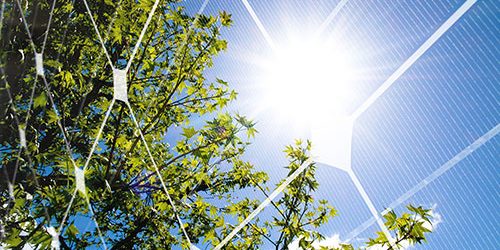
If you’re thinking about installing solar panels on your home, it’s crucial to consider the shading conundrum. For the majority of homeowners, one of the key influences on their decision to install PV is the fact that it provides a clear financial incentive. The government’s Feed-in-Tariff scheme enables homeowners to sell back their surplus energy to the Grid, making a tidy profit in the process. Yet despite the fact that solar panels still function without significant sunlight, when you factor shading into the equation as well, their effectiveness is greatly reduced.
The effect of shading on solar panels:
Each individual solar panel is comprised of a grid of individual solar cells. To put it simply, each individual solar cell that’s in the shade will stop working, whilst its neighbouring panels will continue to work as long as enough light filters through. It’s easy to see how this pattern can affect the overall efficiency of the PV array. Indeed, even just a small amount of shading can have a dramatic effect on the overall output of your panels.
Bypass diodes: a possible alternative?
For poorly performing solar panels, fitting Bypass Diodes to the panels can provide a possible alternative. The design of Bypass Diodes works wonders at tackling inefficiency, helping to maximise on available output. They’re fitted in parallel with a string of PV cells, allowing the current to bypass a set of cells with poorer performance. Visualise a kind of energy enabling mentor that encourages panels to make the most of their overall potential and you get the idea.
Problems and Pitfalls:
So what are the drawbacks? Despite the best of intentions, it all comes down to how things perform in practice. Fitting bypass diodes to every single cell just wouldn’t be practical. For a start, most panel manufacturers fit just 2 or 3 bypass diodes per panel; if bypass diodes were fitted to every single cell this would not only be extremely time-consuming but also prohibitively expensive.
Another problem with this approach is that it doesn’t take into account how even the smallest of system inefficiencies can affect the bigger picture. Even something as seemingly insignificant as shading on a single cell can have far-reaching repercussions, resulting in a loss of at least 30% of a panels overall output in the process. Combine this with the notorious difficulty of redirecting the current from the good cells through the diode (and the large amount of energy this process demands), and it seems like it’s back to the drawing board again to find a more feasible, long-term solution.
Strategies and solutions:
Short of cutting down every single tree in your garden, rest assured that there are several far less dramatic alternatives you could consider:
Option one
Install the panels as normal. Of course, you would have a system that’s not quite as efficient as the best of them, but if you live in a sunnier part of the country (such as Cornwall), and only have a partial amount of shading over your roof, then installing Solar PV can still be a decent, worthwhile investment.
Option two
Choose to install a smaller array. Obviously, it’s in most homeowners best interests to fit as many panels as possible on their rooftop, but in the aforementioned circumstance, a smaller array makes for a smarter solution. Instead of installing panels across the entire surface area of the roof, you would only have panels installed in the unshaded areas, which is both cheaper overall and means that your initial outlay will be money well spent.
Option three
If you’ve got more money to spend, and have overall efficiency as your focus, breaking the array into chunks, with individual inverters for each panel can prove to be a sensible, long-term investment. This option is particularly beneficial for homeowners looking to put down roots, who are planning on remaining in their property for a good few years to come. Although at the top end of the price range, the increased efficiency of this solution can prove to be an attractive proposition to homeowners.